Video Ad Script Template for Products (15 to 20 Seconds)
A video ad script template for a product comes down to four beats: a hook, what the product is, why they want it, and a call to action. For a 15 to 20 second ad that is roughly 32 to 43 words at a natural pace of 130 words per minute (the default on Boords’ commercial script template). That gives each beat one or two short sentences. Fill in the template below, read it aloud against a timer, and cut until it fits.
The 4-beat structure for a 15 to 20 second product ad
TikTok’s own advice for performance ads is to “have a hook, highlight your unique selling points, and end with a clear call-to-action” (TikTok creative best practices). That is the same skeleton, with one change for a short ad. In 15 to 20 seconds you get one selling point, not a list.
Most script templates you’ll find are built for SaaS demos, explainers or 60-second brand films. A single physical or personalized product needs less: the buyer has to see it, feel the payoff, and know what to click.
The template: fill in the blanks
| Beat | Job | Words at 15 s | Words at 20 s | Fill-in line |
|---|---|---|---|---|
| 1. Hook | Stop the scroll and hint at the idea | 6 to 8 | 7 to 9 | ”[Buyer], still [problem]?” or “Your [thing] deserves [product], too.” |
| 2. What it is | Product name plus one visual detail | 8 to 10 | 10 to 12 | ”This is the [product name]. [One thing the viewer can see.]“ |
| 3. Why they want it | The feeling or result, in one moment | 8 to 10 | 11 to 14 | ”[Moment of use], and [reaction].“ |
| 4. CTA | One action, matching the button | 4 to 6 | 5 to 7 | ”[Verb] yours [today].” |
Totals: 26 to 34 words for a 15 second ad, 33 to 42 for a 20 second ad.
Here is where those numbers come from. 130 words per minute is about 2.2 words per second, so 15 seconds is roughly 32 words and 20 seconds roughly 43. I shave a few words off for pauses and the end card. Boords’ 130 is a tool default, not an industry standard, so treat my budgets as a starting point. The reliable method is to read the script aloud with a phone timer and cut words until you land inside the length.
One more recommendation from TikTok: introduce your content proposition in the first 3 seconds, and get the hook done within the first 6 (source). So the hook line should carry the idea of the product, not just a vague attention grab. More openers to borrow are in 30 video ad hooks for products.
Worked example 1: the Forever Love necklace (gift ad, about 20 seconds)
This is one of our finished ads for a gold open-heart necklace sold as a gift for wives. Every scene is AI-made from product photos. For the shot order and end card of this ad and a second one, see product video ad examples broken down shot by shot.
The full voiceover, beat by beat:
- Beat 1, hook (8 words): “Husbands, still stuck on what to get her?” It speaks to the person who pays, not the person who wears it. The ad opens visually on a woman opening the gift box, so the first frame already shows the payoff.
- Beat 2, what it is (15 words): “This is the Forever Love heart necklace. A clear stone floats inside an open heart.” The product name comes first, then one thing you can see: the floating stone. The shots here are the necklace worn at the collarbone and a macro of the pendant.
- Beat 3, why they want it (28 words): “Under it, a card that reads, to my wife, falling in love with you was beyond my control. She opens the box, reads every word, and tears up.” This is the emotional payoff, delivered as a tiny scene: card, reading, tears.
- Beat 4, CTA (5 words): “Grab yours for her today.” The end card repeats the product name with “Grab Yours”.
The whole script is 56 words over about 20 seconds, which is about 2.8 words per second. That is faster than the 130 words per minute budget above, and beat 3 is well over its allowance because it reads the card aloud. Captions help the viewer keep up, but there is no room for a pause. If your read feels rushed, I’d cut the card quote first and keep “She opens the box, reads every word, and tears up.”
Worked example 2: the Cooper dog portrait tee (personalized, 15 seconds)
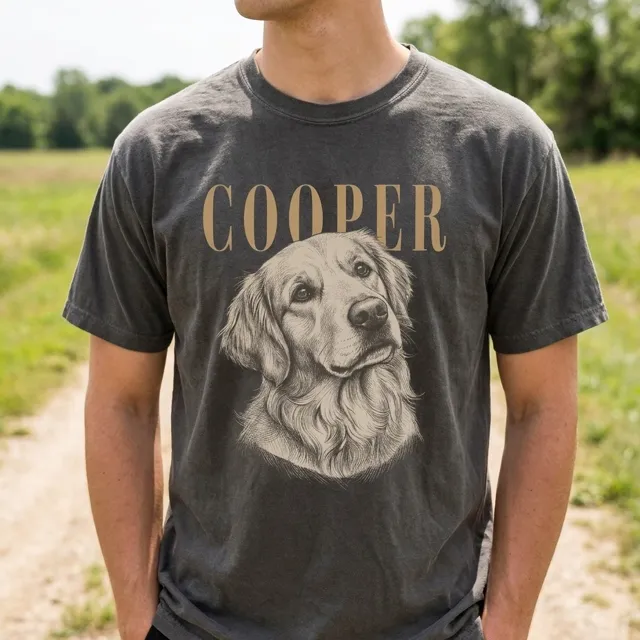
This one is a custom dog portrait tee: a fine-line golden retriever sketch with the dog’s name on a washed charcoal shirt.
- Beat 1, hook (6 words): “Your dog deserves a shirt, too.” It names the idea and the niche in one line. The visual is a woman laughing at her phone on the couch with her dog.
- Beat 2, what it is (21 words): “Upload one photo, type their name, and boom: a fine-line sketch portrait of your best friend on a washed charcoal tee.” For a personalized product, “what it is” has to explain how it works too. The visual detail is “fine-line sketch”, and the shots are a man wearing the tee at a dog park, then a close-up of the print and the name.
- Beat 3, why they want it (10 words): “Wear them everywhere, or gift it to a dog person.” It covers two buyers in one line: the owner and the gift giver. The tee laid flat is the visual.
- Beat 4, CTA (3 words): “Make yours today.” The end card is full-bleed with “Make yours”.
That’s 40 words in 15 seconds, about 2.7 words per second. It is also brisk, with beat 2 over budget because of the how-it-works line. If I were tightening it I’d drop “and boom”.
Script variants for different products
Same four beats, different fill-ins. Each is a skeleton, so write your own details.
Gift for someone (the necklace pattern)
[Buyer], still stuck on what to get [recipient]? This is the [product name]. [One visible detail]. [Recipient opens it and reacts]. Grab yours for [recipient] today.
Personalized product (the Cooper pattern)
Your [pet, kid, home] deserves [product], too. [Step 1], [step 2], and [result]. [Where it gets used or gifted]. Make yours today.
Problem and solution
[The problem, in the words a buyer would use]? [Product name] [fixes it in one clause]. [One thing the viewer can see that proves it]. [CTA].
Seasonal
[Holiday] is coming and [the gift problem]. [Product name]: [visual detail]. [Recipient’s reaction]. [CTA matching your button].
UGC style (first person)
I bought this for [person] and [what happened]. [Product name] has [one visible detail]. [My honest reaction in one line]. [CTA matching your button].
A UGC ad script is written the way one person talks to a friend, in first person, so it should sound said, not narrated. A voiceover script like the two above speaks about the product from outside. TikTok recommends a DIY, not overly polished style that fits in with user-generated content, and I cover how to get that look without hiring anyone in UGC-style ads without creators.
For the seasonal version, check your supplier’s order cutoff before you promise anything in the ad.
Writing for sound off: captions, on-screen text and the first frame
Write the script so it still works if nobody hears it. A few sourced guidelines:
- TikTok recommends captions or text overlays for context and says to display “5-10 words per second when using text” (TikTok). That is about on-screen text, not voiceover pace.
- Meta’s own research with Nielsen found that up to 47% of the value in a video campaign was delivered in the first three seconds and up to 74% in the first ten (Meta, older post). So the first frame and first line carry the ad.
- The same Meta page says one advertiser, A&W Canada, saw a 25% increase in watch time after adding captions. That is one advertiser’s result, not a rule.
- TikTok also recommends vertical 9:16 and a DIY, not overly polished style that fits in with user-generated content (TikTok creative best practices).
- For length, one third-party roundup quotes TikTok’s tips as recommending 21 to 34 seconds for In-Feed ads (Selzee). I couldn’t open the original, so treat that as secondhand. Our 15 to 20 seconds is shorter on purpose: one product, one idea.
In practice, put a person or the product in the first frame, say the idea in the first line, and let captions repeat the key words.
Common mistakes in product ad scripts
- Too many features. At the 130 WPM budget, a 15 second ad has about 32 words. Pick one visual detail (the floating stone, the fine-line sketch) and drop the rest for the listing page.
- A slow open. “Hi, I’m [name] and today I want to talk about” burns the first three seconds. Start on the problem, the buyer, or the payoff.
- A vague CTA. “Check it out” gives no action. Say what the button says. Ecwid’s help page lists TikTok buttons such as “Shop Now”, “Order Now” and “Visit Store” (source). Meta uses a fixed list of buttons with no custom text, according to Coinis. So pick the button in Ads Manager first, then write the spoken CTA to match, for example “Shop now”.
- Writing for the page, not the ear. Long sentences and clauses sound slow when read. Short sentences, one idea each.
Turn the script into an ad without filming
Once the script reads well aloud, you still need footage. If you don’t want to film, there are a few routes, which I cover in how to make UGC ads without creators.
One route is LzyPOD’s product video ad generator. You upload product photos and it writes the script and voiceover, makes new AI scenes of people using the product, and adds word-by-word captions, music and an end card. Your photos are reference only and never appear in the ad. The Cooper ad above started from a single seller photo, a man wearing the tee:
A video ad costs 25, 45 or 60 credits depending on the motion, and the free account’s 15 credits won’t cover one. Script, voice, music or end card edits cost 5 credits each, so you can rewrite a line without regenerating the whole ad. A re-shot scene is 8 credits.
Common questions
How do you write a script for a product video ad?
Use four beats: a hook, the product name plus one visual detail, the payoff, and a CTA. Write one or two short sentences per beat, then read it aloud with a timer and cut until it fits your length.
How many words is a 15-second ad script?
About 32 words at 130 words per minute, the default on Boords’ script template. Brisk reads can stretch to around 40, as our Cooper ad does with 40 words, but that leaves no pauses.
What is the best structure for a TikTok ad script?
TikTok’s own guidance is a hook, your unique selling points, and a clear call to action. Get the hook in the first 6 seconds and introduce your content proposition in the first 3.
What should the CTA in a video ad say?
Match the button you choose in the ad platform, for example “Shop now” or “Order now”. A spoken CTA that matches the button is clearer than a general “check it out”.
Can AI write my video ad script?
Yes. General AI chat tools can draft one if you give them the four beats and a word budget (about 32 words for 15 seconds), then read the result aloud and trim it. LzyPOD’s Video Ads also writes the script and voiceover from your product photos, and you can edit the script afterwards for 5 credits.
Turn one product photo into a video ad
LzyPOD Video Ads writes the script, makes new scenes of your product, adds voice and music, and edits it all into a ready-to-post ad. No filming, no editing.
See example ads → Free to try · no card needed